Students Protest ICE Policies in Portland, Close Businesses in Solidarity
Students chanted and raised their fists as they gathered at Glenhaven Park in Portland on January 30, 2026, joining a general strike to protest recent U.S. immigration policies, violence, and killings. The rally, attended by mostly high school students alongside other community members, reflected a growing wave of youth-led activism across the country. From handmade signs to carefully rehearsed chants, the protest carried both the urgency and creativity of a generation increasingly unwilling to remain silent in the face of systemic injustice.
Marlen Gonzalez, a high school student, fought back tears as she spoke to the crowd, her voice trembling with emotion. Nearby, Maya Fuller, another student, cheered in solidarity, her enthusiasm echoing through the park. Viola DeVigal, an organizer and leader of the demonstration, led the group in protest songs, her voice blending with others as they sang for justice and change. The atmosphere was both somber and defiant, a mixture of grief, frustration, and determination that seemed to vibrate through every corner of the park.
The scene at Glenhaven Park was one of unity and determination. Backpacks and signs were scattered across the playground, symbols of the students' commitment to the cause. Some climbed atop playground structures to get a better view of the speakers, while others listened intently from below. The air was filled with chants of "Stop ICE Terror Now" and "This is what democracy looks like!"—phrases that echoed the energy of student movements nationwide. Parents and community members lined the periphery, some silently supportive, others visibly emotional as they watched young voices demanding change.
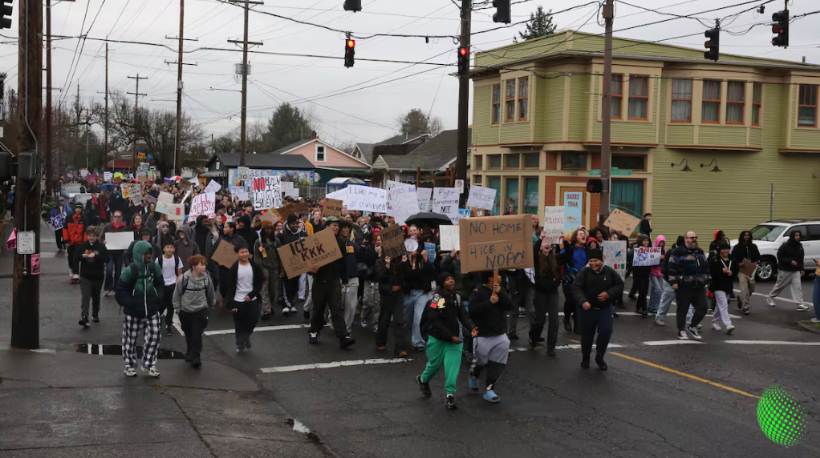
The strike was sparked by recent deadly shootings of two U.S. citizens in Minneapolis and a broader crackdown on immigration enforcement nationwide. Students from McDaniel High School in Northeast Portland marched through the streets in a light rain, their signs held high and their voices unwavering despite the chill. Across town, students from Roosevelt High School walked out and marched down North Lombard Street, mirroring actions across the Pacific Northwest and across the country. Social media amplified the movement, with photos, live streams, and hashtags documenting the demonstrations and connecting them to a national dialogue about immigration, youth activism, and civil rights.
Roosevelt senior Jasmin Reyes-Contreras was among those marching, her voice filled with passion. "We as students care about this issue," she said. "We as students care about the funding that's going to ICE because this is impacting everybody. I mean there's been students who've gotten their parents taken away who go to Roosevelt High School." Her words reflected a personal dimension to the protest, highlighting the ways in which federal immigration policies ripple through communities and classrooms, affecting children and families in profound ways.
McDaniel sophomore Viola DeVigal, who helped organize the rally, spoke about the fear and anxiety felt by many in her community. "It hurts so much to see my community scared to come to school and just scared to be out," she said. About 28% of McDaniel's student body is Latino, and DeVigal said she's heard from students afraid to attend school due to concerns about ICE agents detaining them en route. "We have students who are literally wondering if they'll come home to find their families intact," she added, underscoring the human stakes behind the statistics and policy debates.
Portland Public Schools announced that Friday would be treated as a normal school day, but leaders emphasized that they respect students’ rights to protest and speak out. "We know that recent immigration enforcement actions have caused real harm and deep anxiety in many of our schools and neighborhoods, and we are fully committed to supporting and advocating for our immigrant staff, students, and families," said PPS Superintendent Kimberlee Armstrong in a message to families. School officials also coordinated with local police to ensure the safety of students participating in the marches, acknowledging both the importance of civic engagement and the potential risks involved.
The strike also resonated with small businesses in the Pacific Northwest, many of which grappled with whether to close in solidarity. Mis Tacones, a vegan restaurant in Northeast Portland, decided to shut its doors for the day after consulting with its staff. Owners Polo Bañuelos and Carlos Reynoso, both immigrants themselves, felt it was important to stand with their community. "We want to be able to participate, but this was a collective decision," Bañuelos said. "As a small business, closing is not easy. Many small businesses cannot afford to close." Their choice reflected a balancing act faced by many local entrepreneurs, weighing financial stability against social responsibility and solidarity.
Christine Azar, owner of Azar Indulgences, a chocolate and coffee shop in downtown Portland, chose a different path. Instead of closing, she decided to donate part of her proceeds to support small businesses in Minneapolis affected by recent violence. "I stand in solidarity with everyone that's doing it," she said. "I support it – but I also want to make sure that I am sending my money where it's worthwhile." Azar, an Arab American who immigrated to the U.S. from Canada in 2001, was deeply affected by the shootings in Minneapolis and the climate of fear surrounding federal immigration enforcement. "It's a very scary time and it makes no sense," she said. "This doesn't make any sense at all because it's designed to just harm people, whether it's people that are in the immigrant community, [or] whether it's those business owners that are employing people that are immigrants."
The general strike, promoted extensively on websites and social media platforms, was a response to growing opposition to deportation efforts involving U.S. Immigration and Customs Enforcement and U.S. Customs and Border Protection. Protesters and business owners rallied around the simple mantra of "ICE out now," calling for an end to what they view as violent and discriminatory tactics, while demanding more humane treatment of immigrant communities. The movement drew attention to systemic issues, from racial profiling and over-policing to the psychological impact on children and families whose lives are disrupted by aggressive enforcement measures.
As the day unfolded, the streets of Portland were filled with the energy of youth activism and the determination of a community united in its call for justice. Students carried handmade banners reading “Families Not Fear” and “Education Over Deportation,” while teachers and allies offered encouragement along the march routes. The strike was a powerful reminder of the impact that collective action can have, especially when amplified by social media and community networks. It also highlighted the increasing political engagement of young people, who are refusing to wait until adulthood to participate in shaping policies that affect their lives and communities.
Observers noted that this strike was part of a broader national wave of student activism. Across the U.S., youth-led protests are emerging around a range of issues—from climate change to gun control—but this moment in Portland specifically underscores how immigration policy has become a flashpoint for the next generation of civic leaders. The demonstrators, though often teenagers, displayed a strategic awareness of how public attention, media coverage, and local solidarity can influence broader political discourse.
By the afternoon, the rally at Glenhaven Park had swelled, with students, families, and community leaders marching in a sustained show of force. Local news outlets covered the event, amplifying the voices of students and capturing their chants, speeches, and signs. Social media users shared images and video clips that quickly went viral, drawing attention not only to Portland but also to the broader struggles faced by immigrant communities across the nation. The strike became more than just a local protest—it was a symbol of youth-driven advocacy, a message that the younger generation is willing to organize, mobilize, and demand accountability.
Ultimately, the general strike in Portland on January 30, 2026, was a vivid demonstration of the power of collective action and the role of young people in shaping public debate. Through chants, marches, and speeches, students brought attention to issues of systemic violence, immigration enforcement, and community safety. Their efforts highlighted not just the problems facing immigrant families, but also the resilience, creativity, and courage of a generation determined to make its voice heard. The day served as a powerful reminder that civic engagement knows no age, and that standing up for justice often requires both bravery and a willingness to confront entrenched systems of power.
As Portland’s students returned home, wet and tired but unbowed, the message of the strike remained clear: communities will rally, voices will rise, and the struggle for justice and dignity will continue. For Marlen Gonzalez, Viola DeVigal, Jasmin Reyes-Contreras, and countless others, the strike was a declaration that their city, their peers, and their collective energy cannot be ignored—and that even in the face of fear, hope, solidarity, and action remain powerful tools for change.
Source: OPB News