U.S. Citizen Illegally Detained by ICE in St. Paul, Suffers Injuries
When the stakes are high, access to reliable information becomes more than a convenience—it is essential. Independent journalism serves as a vital safeguard, ensuring that communities remain informed, particularly in moments of uncertainty and crisis. By supporting such reporting, readers help maintain a resource that holds institutions accountable and gives voice to those who might otherwise be unheard.
Last week, Nasra Ahmed, a 23-year-old U.S. citizen from St. Paul, experienced firsthand why that access is so critical. On the morning of Jan. 14, Ahmed stepped outside her apartment, only to be confronted by a swarm of U.S. Immigration and Customs Enforcement (ICE) officers. Within moments, she was surrounded, asked for identification, and subjected to a violent detainment that left her bruised, shaken, and deeply traumatized.
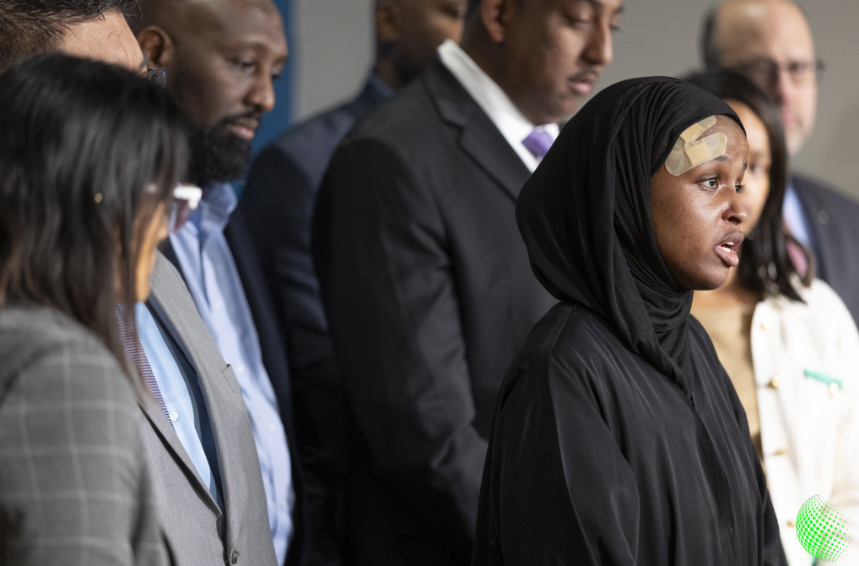
“I’m not a criminal, but they shackled my legs and handcuffed me as if I were,” Ahmed said, recounting her ordeal at a news conference at the Minnesota State Capitol on Wednesday. With a bandage covering the right side of her face, she detailed the force used by the agents: pinned down, elbows and knees pressed into her back, and shoved into a vehicle, sustaining what she was later told was a concussion. She also reported hearing racial slurs as the officers restrained her.
The incident, captured on video by her neighbors, shows more than a dozen officers handcuffing Ahmed and forcing her into a vehicle. The footage paints a disturbing picture of what Ahmed described as an unnecessarily aggressive and unlawful detainment. She was initially taken to the Bishop Henry Whipple Federal Building at Fort Snelling and then transferred to the Sherburne County Jail in Elk River. For 24 hours, her family struggled to obtain any information about her whereabouts.
Her father, Mohamed Ahmed, said he learned of his daughter’s detainment only after her aunt called him. “I couldn’t get any information about her for a whole 24 hours,” he said. Despite his efforts, including coordinating with State Rep. Samakab Hussein, a St. Paul Democrat who attended the news conference, Nasra had already been moved to Elk River. Once her family located her, they presented her passport and birth certificate to prove her status as a U.S. citizen. “This is not immigration enforcement; this is an operation targeting Somali Americans,” Mohamed said.
Ahmed’s emotional account underscored the personal toll of aggressive immigration operations. “This is a scar that I will carry for the rest of my life,” she said, pointing to her face, neck, legs, and wrists. Her tears reflected a broader reality for many U.S. citizens and lawful residents who have been unlawfully detained in Minnesota since December.
The federal government has intensified its presence in Minnesota in recent months. In January, the number of ICE and Border Patrol agents operating in the state increased to approximately 3,000, resulting in more widespread stops, interrogations, and detentions. Homeland Security Secretary Kristi Noem has indicated that hundreds more agents may be deployed, further escalating tensions in communities already wary of federal enforcement.
State Rep. Hussein described the situation as part of a growing pattern. “Calls about ICE activity are flowing in from the community,” he said. “This needs to stop.” The combination of increased federal enforcement and heightened public scrutiny has led to mounting protests across the Twin Cities. Ahmed, like many others, found herself caught in the middle, targeted not for any wrongdoing but because of assumptions tied to her Somali heritage.
“Being American is much more than ICE's racial assumptions,” Ahmed said, emphasizing her dual identity: Somali and American. Her story is a stark reminder that citizenship alone does not always protect individuals from harm when enforcement agencies operate with insufficient oversight.
The broader context adds urgency to the conversation. National tensions have been high, with President Donald Trump threatening to invoke the Insurrection Act, which would allow deployment of military force in Minnesota. For Ahmed and countless others, the reality on the ground is already tense, with ordinary residents feeling the effects of heightened federal intervention in their daily lives.
Experts say Ahmed’s case highlights systemic issues in enforcement practices, particularly those that disproportionately affect Somali Americans and other minority communities. Legal advocates stress the importance of oversight and accountability in immigration operations, noting that wrongful detainment of citizens erodes trust in federal institutions and can cause lasting trauma.
The incident also underscores the indispensable role of independent journalism in shedding light on abuses of power. Without reporters on the ground documenting Ahmed’s experience, the public might never know about the circumstances of her unlawful detainment. Through storytelling, investigation, and careful reporting, journalists provide a critical check on authority, ensuring that vulnerable voices are heard and injustices are not ignored.
Sahan Journal, the nonprofit news organization covering Ahmed’s story, relies on the support of readers to continue its reporting. While the content is free to access, producing it requires resources and dedication. More than 1,900 donors currently support Sahan Journal’s mission, helping maintain its commitment to accessible, high-quality reporting. Contributions from readers make it possible to tell stories like Ahmed’s—stories that hold power to account and inform the public about crucial issues affecting their communities.
Ahmed’s story is emblematic of a wider pattern. While she is a U.S. citizen, many others—including lawful immigrants—have reported similar encounters in Minnesota since late 2024. The escalation of ICE and Border Patrol activity, coupled with limited transparency in detentions, has left communities anxious and distrustful. For families, these events are more than statistics—they are personal crises that can fracture lives and erode a sense of safety.
Through it all, Ahmed has sought to reclaim her agency. Speaking publicly about her experience, she emphasizes the importance of community support and advocacy. “I am Somali, but also American,” she reiterated. Her words capture the tension between identity and enforcement that underpins her case, highlighting the human cost of policies and practices that operate without sufficient oversight.
For Minneapolis-St. Paul residents and others watching, Ahmed’s detainment is a call to action. It is a reminder that civic engagement, community advocacy, and support for independent media are all essential components of a functioning democracy. By staying informed and amplifying voices like Ahmed’s, communities can help ensure that civil rights are protected and that the most vulnerable are not left without recourse.
Ahmed’s ordeal has sparked conversations at the state level and beyond. Lawmakers, advocates, and neighbors alike have voiced concern, emphasizing that unlawful detainment and racially targeted operations must be addressed. As enforcement agencies expand their presence, local officials and communities are grappling with how to balance security with civil liberties and human rights.
At its core, this story is about more than one individual’s suffering. It reflects the challenges faced by entire communities navigating federal enforcement operations that can appear opaque, aggressive, and, at times, unjust. It underscores the need for accountability, transparency, and robust protections for all residents—regardless of their background.
In telling Ahmed’s story, independent journalism fulfills its most important role: giving voice to those affected, uncovering systemic problems, and prompting public dialogue that can lead to meaningful change. The scars Ahmed carries are physical and emotional, but through her willingness to share her experience, she contributes to a broader effort to ensure that similar incidents are not repeated.
The incident in St. Paul, and the broader patterns it represents, serve as a reminder that democratic accountability requires vigilance. Citizens, journalists, lawmakers, and community members must work together to ensure that federal powers are exercised responsibly, with respect for civil rights and human dignity. By supporting independent reporting, readers play a critical role in keeping these stories alive and prompting action to address systemic injustices.
Ahmed’s story is both a personal tragedy and a public call to action. It is a reminder that freedom and citizenship are not merely legal designations—they are lived experiences that require protection, advocacy, and attention. For her, and for countless others affected by aggressive enforcement practices, telling the story is a step toward justice.
This reporting was produced by Atra Mohamed, a freelance journalist for Sahan Journal, whose work continues to highlight pressing issues affecting Somali-American and immigrant communities in Minnesota. Independent journalism, sustained by readers and donors, ensures that stories like Nasra Ahmed’s are not only told but heard by those who can help bring about change.
Source: Sahan Journal