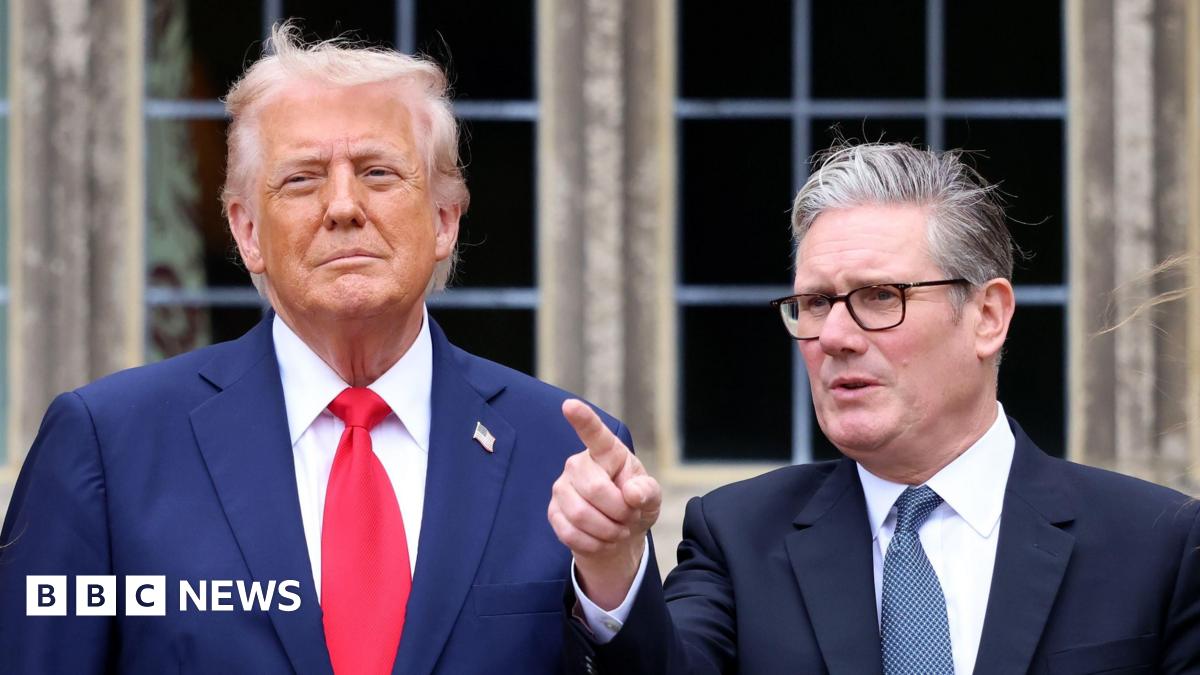
Starmer brands Trump's plan to apply tariffs over Greenland 'completely wrong' - BBC
Denmark's Mette Frederiksen says Europe will not be 'blackmailed' in the face of Trump's tariff threats We're closing our live coverage shortly, but before we go - here's a reminder of the key responses we've heard today to Donald Trump's latest tariffs threat: We're expecting world leaders to meet on Wednesday when they convene for the World Economic Forum in Switzerland - where tariffs are likely to be at the forefront of discussions. You can read more about the latest developments in our story. French Foreign Minister Jean-Noël Barrot is set to speak with his counterparts from all eight countries targeted by Donald Trump's new tariffs this evening, according to a French official. The official says the minister spoke on Saturday to British and German foreign ministers as well as representatives from the EU, immediately after Trump declared that eight Nato allies would face 10% tariffs on exports to the US from February, rising to 25% in June. Now, the official tells reporters, Barrot "will be in contact by this evening with all foreign ministers of the countries affected by the tariffs". "Since yesterday, he has been in discussions with his 27 European counterparts as well as with the political groups in the European Parliament," the official adds. As we've reported in the previous post, Starmer says today he's reiterated the UK's position on Greenland during a phone call with US President Donald Trump. The prime minister has consistently maintained that Greenland "is part of the Kingdom of Denmark and its future is a matter for the Greenlanders and the Danes". Shortly after Trump announced tariffs on eight European allies on Saturday, Starmer reiterated his stance - representing a rare public rebuke to the president. "Applying tariffs on allies for pursuing the collective security of Nato allies is completely wrong. We will of course be pursuing this directly with the US administration," Starmer wrote on social media. Again, speaking to Laura Kuenssberg this morning, Starmer's Culture Secretary Lisa Nandy said the UK will not compromise on its position. She said Trump's threats were "deeply unhelpful and counterproductive", and suggested that an "adult debate" with the White House was needed over the issue, which Trump says is a matter of national security. In the last few minutes, we've heard from a spokesman for UK Prime Minister Keir Starmer, who says the PM has spoken with Donald Trump on the phone today. "The Prime Minister reiterated his position on Greenland. He said that security in the High North is a priority for all Nato allies in order to protect Euro-Atlantic interests," the spokesman says. "He also said that applying tariffs on allies for pursuing the collective security of Nato allies is wrong.” The spokesman adds that Starmer also spoke to the Prime Minister of Denmark Mette Frederiksen, President of the European Commission Ursula von der Leyen, and Nato Secretary-General Mark Rutte today. Adam GoldsmithLive reporter The leaders of eight countries targeted by the US president's fresh set of tariffs have spent the day issuing defiant messages of unity against Donald Trump's threats. A joint statement from Denmark, Finland, France, Germany, the Netherlands, Norway, Sweden and the UK warned of a "dangerous downward spiral" should Trump complete his ambition to take control of Greenland. It came after an emergency meeting in Brussels, convened as a response to Trump's threats to tariff exports from the eight countries to the US at 10% from 1 February, rising to 25% in June. Soon after, Denmark's Prime Minister Mette Frederiksen followed up with a declaration that "Europe won't be blackmailed" into handing over Greenland - an autonomous territory that Denmark currently controls. And Danish Foreign Minister Lars Løkke Rasmussen met his Norwegian counterpart to discuss the latest escalation. He said he hopes talks with the US will continue "so that the president gives up his dream of taking over Greenland". As our White House correspondent reports, we've heard little from Trump himself today after yesterday's Truth Social threat dropped. But, his Treasury Secretary Scott Bessent reiterated that Europeans will understand US control of the territory is "best for Greenland". Nick EdserBusiness reporter If President Trump’s threat to impose tariffs over Greenland is carried out, the economic impact would be “modest”, but the “political and geopolitical consequences would be much greater”, according to Neil Shearing, group chief economist at Capital Economics. He says that the past year has shown that the economic effects of tariffs are uncertain. However, the UK and Germany are most exposed as they have the largest export shares to the US. “A 10% tariff could reduce GDP in those economies by around 0.1%, while a 25% tariff could knock 0.2–0.3% off output,” he says, adding that the levies would add a similar amount to US inflation. He also notes that imposing tariffs on a handful of EU countries, but not on the whole of the EU, would “presumably result in widespread rerouting of trade within the free trade bloc in order to avoid the tariffs”. However, Shearing says the political ramifications would be far more serious. “Any attempt by the US to seize Greenland by force or coerce Denmark into ceding the territory would drive a wedge through transatlantic relations and inflict potentially irreparable damage on Nato.” Texas Republican Rep Michael McCaul has expressed skepticism about Trump's proposed plan to annex Greenland. “If we want to put more military in there, we can, we don't have to invade it," he tells ABC This Week. "If you want to buy it, that's fine. But I don't see a willing seller right now." McCaul, who's the former chair of the House Foreign Affairs Committee, also issues a stark warning against any US military action in Greenland. "For [Trump] to militarily invade, would turn Article 5 of Nato on its very head. And in essence, it would put us at war with Nato itself." "It would end up abolishing Nato as we know it." This is not the first time the US has tried to gain control of Greenland - the world’s largest island. It’s not even the first time Donald Trump has tried to purchase the territory. Our colleagues at BBC Future have created a timeline looking at the US’ previous efforts to obtain the Arctic island: You can read more about the history of Greenland and minerals hiding under its ice on BBC Future. Jessica ParkerBBC News Berlin correspondent The reconnaissance mission in Greenland has been "completed as planned", a spokesperson for Germany's Bundeswehr Joint Force Command says. The mission, which caused some stir from the White House, saw several European states deploy small numbers of troops to the Arctic territory. The spokesperson says the mission was originally scheduled to take place between 15 and 17 January, but "following consultations with our partners, we added an extra day for coordination in Denmark". Weather conditions meant one of the stations they planned to reach could not be visited, they add. "Nevertheless, important insights were gained, which will now be used to coordinate possible joint measures with our partners and within the Nato framework to strengthen security in the North Atlantic and the Arctic," the spokesperson concludes in their update to the BBC. Joe InwoodWorld news correspondent "'We must strengthen Arctic defences to deter Putin' Foreign Secretary says during Arctic visit." That was the headline of a British Government press release just four days ago. In it, the threat from Russia was repeatedly highlighted. The only mention of the United States was a reference to their cooperation in intercepting Russian tankers. That press release came around the same time that several European states announced they were sending small numbers of troops to Greenland, a reconnaissance mission ahead of a new operation called "Arctic Endurance". The stated aim of that mission, involving Denmark, Norway, Sweden, France, Germany, the United Kingdom, the Netherlands, and Finland, was to "strengthen the (Nato) alliance’s footprint in the Arctic, benefiting both European and transatlantic security.” Once again, there was no mention of the United States. In short, Denmark portrayed this as Europe’s attempt to demonstrate that it could - and would - take the security of the Arctic seriously - something the US had repeatedly - and very publicly - questioned. This was not how Donald Trump seems to have interpreted it, however. Writing on his Truth Social platform, he wrote that the Europeans had "journeyed to Greenland, for purposes unknown". He went on to say that "these Countries, who are playing this very dangerous game, have put a level of risk in play that is not tenable or sustainable". The same post went on to announce the punitive tariffs that have caused such uproar. What was designed as a mission to reassure the United States, seems to have been interpreted as a hostile act to deter it. The European countries will be hoping this was a genuine misunderstanding, rather than the diplomatic equivalent of a false flag attack. Over the last week, Denmark has increased its military presence in Greenland in response to increasing pressure from the United States. Fresh agency pictures show a group of Danish soldiers arriving in the Greenlandic capital, Nuuk, today as part of Copenhagen's increased activity in the territory: Nick BeakeEurope correspondent, reporting from Brussels In Brussels, you can see little fanfare around this hastily-convened meeting. It’s not like a big leader’s summit. We are talking about ambassadors who often work in the background and there’s certainly been no procession of diplomats opining to the cameras on the fringes of these crisis talks. There is a great irony that one of the options they’ll discuss is a potential tariff retaliation on the US – deploying the EU’s bazooka, as it’s known – which was originally designed to combat any bullying interference from a hostile external power. They were thinking of China, not the US. Europe has rolled out the red carpet for President Trump in his second term. Some have called it shrewd, others sycophantic. But now there’s a distinct feeling he’s not just pulling up the Transatlantic diplomatic drawbridge, but threatening to blow it up altogether. Bernd Debusmann JrTravelling with President Trump I'm currently in West Palm Beach, Florida, where I'm among the members of the White House press pool travelling with Donald Trump for the long holiday weekend. For the last several hours, Trump has been inside the nearby Trump International golf course, away from the prying eyes of the media. While we've heard some lawmakers and other senior officials discuss Greenland so far today, we've not actually heard from Trump regarding the issue since he announced the tariffs via Truth Social yesterday. Much of his attention, it seems, is on domestic concerns - most notably the ongoing protests over ICE in Minneapolis and the showdown between the federal government and local politicians. That issue is one that has continued to eat up significant portions of the US media's attention, even as it continues to be dominated by Trump's designs on Greenland. We have no expectation of seeing Trump or hearing from him directly today, as he has no public events on his calendar. It is always possible - and perhaps likely - that we will hear from him on Truth Social. Jessica ParkerBerlin correspondent It’s not unusual for representatives from the 27 member states to be swiftly convened for crisis talks. But, unsurprisingly, not everyone is going into the room sounding as gung-ho as France. President Emmanuel Macron is urging the EU to use "Anti-Coercion Instrument” (ACI) - or "trade bazooka" - if the US does impose fresh tariffs in the standoff over Greenland. But one Brussels diplomat insisted it’s "too soon" for such talk and that the emphasis should first be on "diplomacy". Discussions - I’m told - will be broader than just the bazooka. There does appear to be some hope that these further tariffs won’t, in the end, happen. Wishful thinking? Only Donald Trump knows. A challenge for the EU - and its response - is that only a handful of member states have been targeted with this latest tariff threat. If you’re not one of those countries, do you want to risk attracting Donald Trump’s ire by talking tough about possible EU-wide counter-measures? However, member states will also know that any tariff pain will - in the end - be shared. After all, the EU has a highly integrated market. And among the nations that have been named on Trump’s list are Germany and France - the bloc’s two biggest economies. Mark Rutte met Trump at the White House back in October Nato's Secretary General Mark Rutte says he has spoken with US President Donald Trump on the situation in Greenland and the Arctic. In a post on X, following the talk with Trump, Rutte says: "We will continue working on this, and I look forward to seeing him in Davos later this week." As a reminder, Trump will be attending the World Economic Forum in Davos, Switzerland, later this week - as will the leaders of France, Germany, the Netherlands and Finland. Back to Norway's Barth Eide, who says Nato members - including the eight nations threatened with the tariffs - are ready to work with the US to strengthen security in the Arctic. "Of the eight countries who happen to be in the Arctic, seven are Nato members," he says. "So we're actually well prepared to deal with existing and future security challenges in the Arctic." The Norwegian foreign minister says "the very essence of Nato is to protect the sovereign and territorial integrity of its member states" - reiterating his country's support to Denmark. Both foreign ministers now respond to a question in English, as they are asked what immediate actions are being considered. Danish foreign minister Lars Løkke Rasmussen says allies "must follow more than one track," and stresses that he has been looking to have "constructive dialogue" with the US "free from social media and headlines and strong words". He says this dialogue was opened during his trip to Washington last week, adding: "We will stay on track unless the US decides differently." You can see more of his comments in the short video below: This video can not be played More now from the news conference in Oslo. Danish foreign minister Lars Løkke Rasmussen had only just returned from a trip to Washington when Trump issued his latest round of tariffs. And, he tells says that he had a "constructive conversation" with Trump officials. He says he hopes to continue these talks "so that the president gives up his dream of taking over Greenland", according to a translation from local media. He adds that Trump's announcement comes at the same time that European allies attempt to address the task "that Trump believes we have neglected". The foreign ministers of Denmark and Norway have just left the new conference, stay with us as we bring you their final comments. Danish foreign minister, Lars Løkke Rasmussen, on the left The Danish foreign minister, Lars Løkke Rasmussen, speaks next at the news conference in Oslo and describes Trump's decision to impose tariffs on its European Nato allies as "very paradoxical". Rasmussen cites the recent security operation "Arctic Endurance" as an example of Denmark and its partners' commitment to protecting the area, according to Danish broadcaster DR. "And that has led to these tariffs. And it is very, very paradoxical," he says. Norwegian Foreign Minister Espen Barth Eide We can bring you some fresh comments from Norwegian Foreign Minister Espen Barth Eide, as he speaks at a media conference alongside his Danish compatriot in Oslo. In remarks translated by Danish Broadcasting Corporation DR, Eide calls this "a historic and dramatic time", and describes Trump's tariffs as "threats". But, the foreign minister adds, Norway and its allies "will not let ourselves be pressured".