Live updates: Trump speaks about US economy in Detroit - BBC
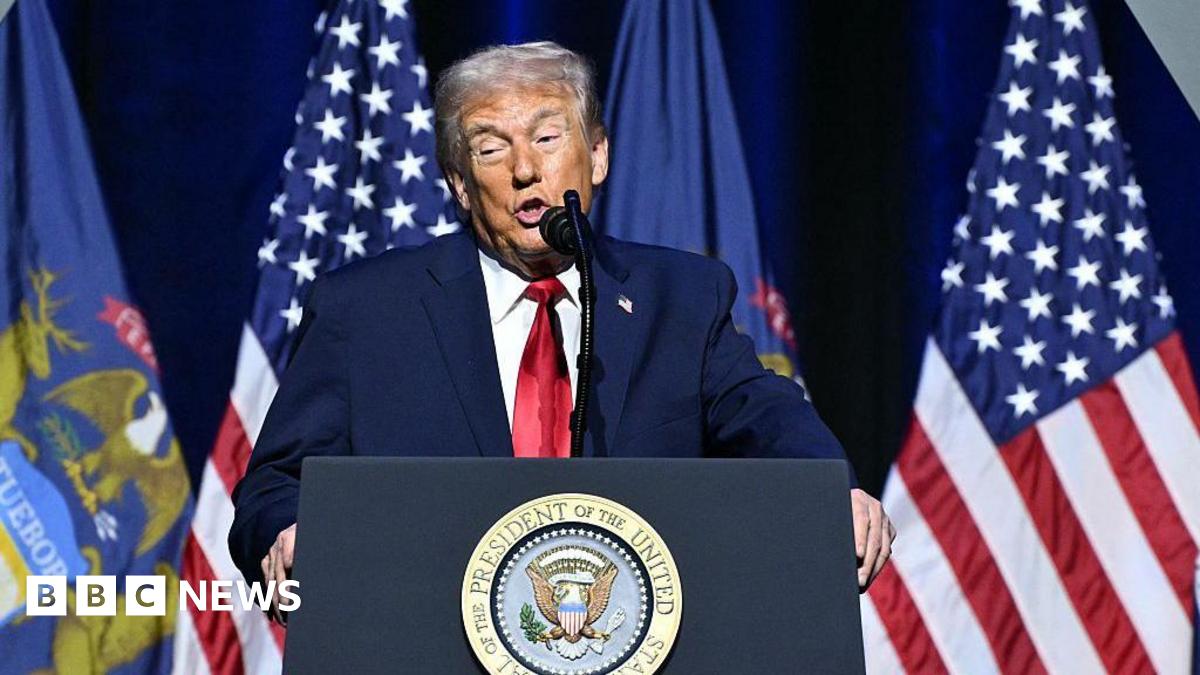
Daniel BushWashington Correspondent The Detroit Economic Club has historically served as a venue for presidents to deliver substantive speeches on the economy. Today, President Trump gave a free-wheeling address that at times more closely resembled a campaign rally. Trump veered from the economy to discuss foreign affairs, including the protests engulfing Iran. "To all Iranian patriots: keep protesting," Trump said at one point. The president also criticised Democrats and alluded to his escalating feud with Federal Reserve chair Jerome Powell. The speech did not include many specific plans to address the issue of affordability, a top concern for many Americans that could dominate the 2026 midterms. He said he would introduce a "healthcare affordability framework" later this week, but offered few details. Trump went on to speak about undocumented immigrants and criticised Democratic California Governor Gavin Newsom, a potential 2028 White House contender. With the speech over and Trump heading back to the White House, we are now ending our live coverage. You can follow our live coverage on the situation in Iran here. You can get in touch in the following ways: Please read our terms & conditions and privacy policy In some cases a selection of your comments and questions will be published, displaying your name and location as you provide it unless you state otherwise. Your contact details will never be published. Danielle KayeNew York business reporter Trump's speech has now finished. He used it to tout efforts to address affordability - including one related to housing costs, a key issue among American families. Last week, he directed Fannie Mae and Freddie Mac, the government-backed housing finance firms, to buy $200bn worth of mortgage bonds. The average rate on a 30-year mortgage fell below 6% for the first time in nearly three years following his announcement. "And that's not with the help of the Fed," Trump said in Michigan. (The Fed's benchmark rate can indirectly affect mortgage rates.) But housing economists have cautioned that the move might not push mortgage rates substantially lower in the long run. "The key now is the timing and cadence of these purchases, which will determine whether the impact is healthy or introduces volatility into the mortgage market," said Jeff DerGurahian, head economist at loanDepot, a mortgage lender. Trump says to provide relief to hard-working Americans, his administration will be "confronting one of the biggest factors in driving up prices", referring to "the monstrosity known as the unaffordable care act". The Affordable Care Act - which is often referred to as Obamacare - was "a gift to make health insurance companies rich at the expense of the American People", he says. "I want the money... to go directly to the people, so they can buy the healthcare that's right for them... That’s why later this week, I'll announce our healthcare affordability framework that will reduce premiums for millions." He says he will lower drug prices, deliver price transparency and "demand honesty and accountability from insurance companies" all over the country and world. Trump emphasises his support for the US oil and gas industry, touting lower gas prices. He says he wants to end the "radical left war on oil and gas" and "the crusade to kill American energy". He says everyone shouldn't have to have an electric car. "They wanted everyone to have an electric car in a short period of time," he says. "I want you to have gasoline powered cars, I want you to have electric, I want you to have hybrids, I want you to have everything." Bernd Debusmann JrReporting from the White House We've just had brief comments from President Trump on Iran, in which he told Iranian "patriots" to "take over their institutions" as protests continue. Trump also reiterated his earlier Truth Social post, telling Iranians to "save the names" of those involved in repression, adding that they will "pay a big price". While the US president again vowed that "help is on the way", he provided no details, other than to note the previous announced tariffs on countries doing business with Iran. This is, in a way, classic Trump. He is known for keeping his decision making process reserved for a small inner circle of White House officials. The first word we may have on what he chooses to do may well come when reports emerge from Iran - as was the case with the raid on Venezuela earlier this year. Trump was not present earlier when senior national security officials met to discuss the situation, White House Press Secretary Karoline Leavitt said earlier today. We're about 40 minutes into Trump's speech, and he takes aim at the Republican lawmakers who push against parts of his agenda. He name-checks Senator Mitt Romney (who he says "votes against everything"), Senator Rand Paul (who Trump calls a "a stone cold loser") and Lisa Murkowski and Susan Collins ("disasters," Trump says). He refers again to Venezuela, calling it "one of the most successful attacks ever" but shows frustration at lawmakers who have spoken against US involvement. "We have a great party, but we have people, whether you like them or not, they stick together like glue. They have horrible policy... because they're smart, they're evil, they're vicious, but they have bad policy." Danielle KayeNew York business reporter Trump claims that inflation has been "defeated". That echoes his comments on social media earlier today, lauding new inflation data released this morning showing that the pace of price increases was relatively contained in December. But economists warn that lower and middle income Americans are being hit particularly hard by rising prices, even though, broadly speaking, Trump's tariffs haven't had as big an impact on prices as initially expected. Overall, consumer prices rose 2.7% from a year ago in December, the same pace as November, according to the Bureau of Labor Statistics. That figure, while relatively subdued, is still above the Federal Reserve's 2% target. The pace of price increases also varied by sector. Food prices, which are at the heart of many Americans' qualms about the economy, rose 3.1% from a year earlier and grocery prices, specifically, rose 2.4%. Energy prices rose 2.3% year-over-year. On the other hand, prices for used vehicles, some types furniture and gasoline all fell from the previous month. Trump uses the speech to take a victory lap about his tariff policies, which he claims have brought in hundreds of billions of dollars into the US from foreign countries. He complains that the legality of the sweeping levies is now up for question in the Supreme Court. "One of the biggest reasons for this unbelievable success has been our historic use of tariffs. It was the tariff that made America strong and powerful in past generations," he says. The tariffs are being challenged by a number of small businesses and a group of US states. They contend that the president exceeded his authority in imposing the extra taxes, which are levied on goods coming into the country. If the Trump administration loses the argument, the government could have to refund some of the billions of dollars it has collected. Daniel BushWashington correspondent President Trump appears in a buoyant mood, with his speech to the Detroit Economic Club - meant to showcase his economic policies since returning to office - taking in a host of other talking points. Before turning to the economy, Trump touted the recent US operation in Venezuela, calling it "flawless" and saying that "winning is a good thing." Trump also repeatedly attacked his predecessor, former President Joe Biden and argued that under his watch the economy had made significant progress over the past year. "We'll go down as the greatest first year in history," Trump said. Trump also mentioned that "tariff" was his favourite word - a frequent riff in his speeches - and noted that he enjoyed departing from his prepared remarks. "I go off the teleprompter about 80 percent of the time," he said. Trump describes Fed chair Jerome Powell as "a real stiff" and says he wants to go back to "the old fashioned way" of economics. "That's the right way. Today, if you announce great numbers, they raise interest rates to try and kill it, so you can never really have the kind of rally you should have," he says. He forecasts that "we're going to have a lot of great months, a lot of great quarters" and adds that he wants the market "to go up". "Our growth potential is unlimited, and could be much higher if we went back to sanity. We're not doing it anymore," he says. Trump says he wants someone to lead the Fed that "when the market is doing great, interest rates can go down". Trump briefly returns to the topic of Venezuela. "Now, I'm Venezuela's biggest fan, we're working with them," he says. "We'll make that country very strong again." He adds that the US is taking in "millions and millions of barrels of oil" worth billions of dollar from the country. "We're gonna get oil prices down even further," he says. Trump has briefly mentioned Venezuela, and the US seizing 50 million barrels of oil. But he weaves between topics, and returns to talking about what he sees as the key achievements of his second administration, now nearly a year in. Trump claims that "growth is exploding, productivity is soaring, investment is booming, incomes are rising" and that "inflation is defeated". He boasts that growth is at an all-time high, and about new highs in the stock market. Economic data released today showed consumer prices rose 2.7% from a year ago, which is above the Federal Reserve's 2% target. Data from last month says the US economy expanded at a better-than-expected annual rate of 4.3%. Bernd Debusmann JrReporting from the White House Late last year, I was at the White House and asked President Trump whether we could expect to see him "on the road" more in 2026 to deliver his economic message, particularly ahead of the midterm elections. He quickly brushed off my question, saying that he doesn't worry about the midterms and rattling off a list of what he sees as economic accomplishments. But White House officials have said that we're likely to see him traveling more to try and convince voters that what he is doing is working. Poll after poll has shown that many Americans - including many Republicans - remain concerned about affordability and high prices. The president, however, has shrugged off those concerns, calling affordability a "hoax" created by the Democrats, and blamed Biden for any lingering economic woes. Today's address in Detroit, it appears, is the first of many similar speeches we can expect in the next year. Trump reminds the crowd that he visited Michigan and spoke to the Detroit Economic Club in 2024 - in the height of the 2024 election. At the time, he laid out his plans for the economy, jobs and manufacturing. Now, he touts the state of economy since he's taken office, calling America "the hottest country anywhere in the world". The US economy is the main talking point for the president today, but that doesn't mean he will stick to the script. Trump describes his style of speaking as the "weave", where he frequently breaks off into tangents about other topics. And there are a lot of big topics he could address. In Iran, thousands are feared dead after a crackdown on anti-government protests which have been ongoing for weeks. Trump has urged for the protests to continue and has floated the possibility of US intervention. In Venezuela, it's been mere weeks since US forces seized President Nicolás Maduro. What happens next in the country is uncertain. And in the state of Minnesota, Trump has warned of a "day of reckoning" after days of protests against federal immigration agents. The protests started after an ICE agent shot and killed 37-year-old Renee Good in Minneapolis last Wednesday. President Donald Trump is on stage and has started speaking. He thanks the club for having him after his visit to the Ford automotive plant in nearby Dearborn, Michigan. You can click watch live at the top of this page to follow along. Answering more press questions at the Ford production plant, Trump addressed the criminal investigation of Federal Reserve chair Jerome Powell. "Hopefully he'll be out of there soon," the president said. In a highly unusual move, external, Powell said on Sunday that the US Department of Justice (DoJ) served the agency with subpoenas and threatened a criminal indictment over testimony he gave to a Senate committee about renovations to Federal Reserve buildings. "It's the most expensive construction job in history, and it's only a renovation," Trump says. "I could have done that job for $25m. They're spending billions and billions." Powell has said he believed the investigation was opened due to Donald Trump's anger over the Fed's refusal to cut interest rates despite repeated public pressure from the president. "This is about whether the Fed will be able to continue to set interest rates based on evidence and economic conditions, or whether instead monetary policy will be directed by political pressure or intimidation," Powell said in a video response. Danielle KayeNew York business reporter Trump's tour of a Ford production plant comes one month after the carmaker said it will scale back its electric vehicle ambitions. The company has scrapped its plans to manufacture large EVs. As part of those changes, it will no longer produce a purely electric version of its popular F-150 pickup truck. The Trump administration has taken steps in recent months to roll back incentives and regulations that had been expected to lead to increased take-up of electric cars. A government subsidy previously helped knock as much as $7,500 off the price of certain battery electric, plug-in hybrid or fuel cell vehicles - but that tax credit ended in September. Trump also recently announced plans to loosen fuel economy rules, reversing another Biden-era policy that had raised hopes of an EV boom. The business case for leaning heavily into EV production, specifically large-sized EV models, has "eroded", Ford said in a statement in December, "due to lower-than-expected demand, high costs and regulatory changes". US President Trump visits the Ford production centre in Dearborn, Michigan. We've just received the first comments from President Trump's visit to a Ford production centre in Dearborn, Michigan, where he took a tour ahead of his speech in Detroit. He spoke positively of the automotive industry in the US. He said the US didn't need the USMCA trilateral trade, which facilitates trade among North America's three biggest economies; the United States, Mexico and Canada. "There's no real advantage to it, it's irrelevant," he said, adding he wanted to build cars "here, not in Canada". He also mentioned Iran, and the next Fed chair. But he did not offer any new information on either. Trump speaks with Ford CEO Jim Farley and Corey Williams, Ford River Rouge Plant Manager.