Iran protests: Tehran ready for 'war and dialogue' with US - DW
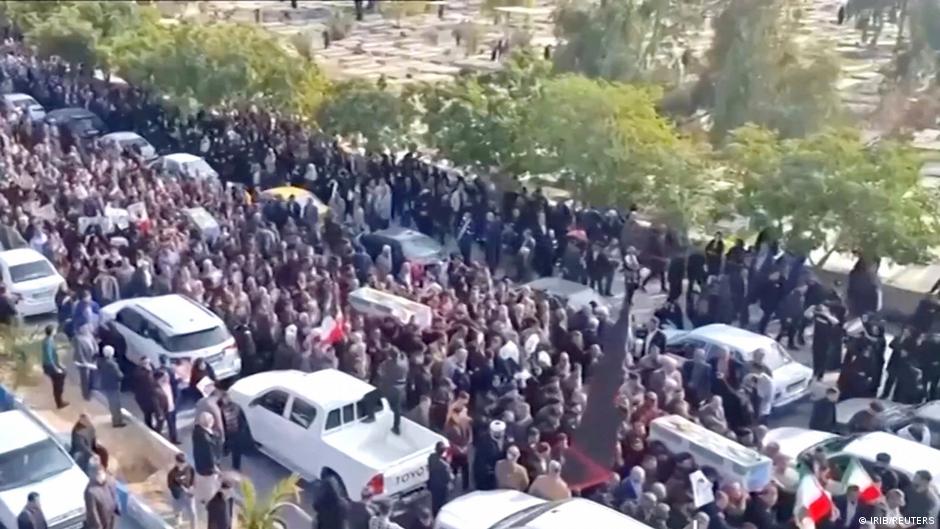
The White House says the president is considering military action against Iran to halt its clampdown on protests — but a channel for diplomacy remains open. A rights group say nearly 650 people have been killed. US President Donald Trump considers range of options — including military action against Iran He has also announced a 25% tarrif on any country doing business with Iran Death toll rises to more than 600, rights group reports European Parliament bans Iranian diplomats This blog has now closed. Read below the latest headlines, analysis and backgrounders on the Iranian protests on Monday, January 12: US President Donald Trump said any country doing business with Iran would face a tariff of 25% on "any and all business being done" with the US. Trump made the announcement on his social media platform. "Effective immediately, any Country doing business with the Islamic Republic of Iran will pay a Tariff of 25% on any and all business being done with the United States of America," Trump wrote. "This Order is final and conclusive." German airline group Lufthansa delayed a plan to resume flights to Tehran on January 16 after an interruption of about seven months. "Due to the current situation, Lufthansa decided on Monday afternoon to suspend its flights to Tehran until Wednesday, January 28," a spokesperson said. "The safety of passengers and crew is always Lufthansa's top priority," the spokesperson added. Protests have broadened in Iran since they first erupted in the capital, Tehran, in December, with demonstrators now calling for an end to clerical rule. To view this video please enable JavaScript, and consider upgrading to a web browser that supports HTML5 video White House Presss Secretary Karoline Leavitt said President Donald Trump was considering strike options against Iran in response to reports that the regime is violently suppressing protests in the country. "I think one thing President Trump is very good at is always keeping all of his options on the table," Leavitt told reporters. "Airstrikes would be one of the many, many options that are on the table for the commander-in-chief. Diplomacy is always the first option for the president. He told all of you last night that what you're hearing from the Iranian regime is quite different from the messages the administration has received privately," she said. Iran's foreign ministry spokesperson earlier in the day said a channel of communication between Iranian Foreign Minister Abbas Araghchi and US Special Envoy Steve Witkoff "remains open." Iran is ready to negotiate with the US based on "mutual respect and interests," Araghchi said Monday. The remarks come months after Israel and the US launched airstrikes targeting nuclear facilities across Iran last June. Supreme Leader Ayatollah Ali Khamenei praised counterprotesters, saying they "accomplished a great deed" in a post on X. "In the name of God, the Compassionate, the Merciful. The great Iranian nation, today you accomplished a great deed and made a historic day," Khamenei wrote, along with a picture showing a large pro-government rally. Earlier in the day, pro-government demonstrators marched in Tehran, according to AFP. Images from the state broadcaster showed people carrying banners with slogans in Persian reading "Death to Israel, Death to America." Crowds gathered at the Enghelab Square, or "Islamic Revolution" Square, where they listened to a speech delivered by parliament speaker Mohammad Bagher Ghalibaf, who railed against Western intervention. Iran's semiofficial Tasnim agency posted footage of the rally on X. Ghalibaf said Iran was fighting a "four-front war," including an economic war, a psychological war, a "military war" with the US and Israel, and a war against protesters who have taken to the streets since late December. Iran's government has taken a hard line against protesters, clamping down on demonstrations and cutting off internet and phone lines. The internet blackout has made gauging information about demonstrations all the more difficult from abroad. With protests raging in Iran, the United States has threatened to intervene militarily if the regime clamps down further. But there are also signs that Washington and Tehran want to talk. Could the current crisis lead to a deal? To view this video please enable JavaScript, and consider upgrading to a web browser that supports HTML5 video French President Emmanuel Macron condemned the Iranian regime's clampdown on protests, which the Norway-based NGO Iran Human Rights (IHR) estimates has killed 648 people. "I condemn the state violence that indiscriminately targets Iranian women and men who courageously demand respect for their rights," Macron wrote on X. "Respect for fundamental freedoms is a universal requirement, and we stand alongside those who defend them," he added. What began in late December as demonstrations sparked by ongoing economic malaise in Iran has since morphed into large-scale anti-government protest. Iran Human Rights said the death toll could be much higher amid an ongoing phone and internet shutdown that has made it "extremely difficult to independently verify" reports from inside Iran. The IHR estimated 10,000 people have also been arrested. US President Donald Trump says Iran wants to negotiate as hundreds of people have been reported killed in the government's clampdown on protests. DW asked Iran analyst Sara Bazoobandi about the prospect of talks between Tehran and Washington. To view this video please enable JavaScript, and consider upgrading to a web browser that supports HTML5 video Iran called in the ambassadors of Germany, France, Italy and the United Kingdom to discuss what it said was support for mass protests across the country. The demonstrations began at the end of December over economic grievances, but they have since taken a turn — with protesters demanding an end to the ruling clergy of the Islamic Republic that was established nearly five decades ago. The diplomats were shown a video of the damage caused by "rioters" and told their governments should "withdraw official statements supporting the protesters," the Foreign Ministry said in a statement carried by state television. Germany's Foreign Office confirmed that its ambassador had been summoned. The French Foreign Ministry also onfirmed the news, saying European ambassadors were summoned over protests. The EU is reportedly also gearing up to impose new sanctions against Iran as details emerge about hundreds of people reportedly having been killed by security forces as dissent spreads across the country. The European Parliament has banned all Iranian diplomats and representatives from its premises in Brussels, Strasbourg and Luxembourg. European Parliament President Roberta Metsola posted to X, writing: "It cannot be business as usual. As the brave people of Iran continue to stand up for their rights and their liberty, today I have taken the decision to ban all diplomatic staff and any other representatives of the Islamic Republic of Iran from all European Parliament premises." "This House will not aid in legitimising this regime that has sustained itself through torture, repression and murder," she said. A Kurdish civil activist inside Iran told DW Persian in a phone call that there has been a "large-scale transfer" of Islamic Revolutionary Guard Corps (IRGC) forces to the country's western provinces. The activist, who contacted DW using Iraqi mobile operators from a border village, described what he has witnessed on the ground. According to him, in at least the provinces of West Azerbaijan, Kurdistan, Kermanshah and Ilam, access points to many cities have been blocked and numerous checkpoints have been set up. IRGC forces are stopping vehicles, searching them, and in some cases forcing citizens to unlock their mobile phones. The source also reported that heavy military equipment and IRGC special forces have been deployed in border areas, including Sardasht in West Azerbaijan and Baneh and Marivan in Kurdistan province. He said these measures have severely disrupted the daily lives of border villagers, imposing sweeping restrictions on movement and local activities. The activist further emphasized that the complete shutdown of internet and phone services has brought everyday life in Iran to a standstill. He said that people's only remaining access to information is through satellite television, which in most cities is heavily jammed. He added that the circulation of images showing the killing of protesters in Tehran has deeply affected people and fueled widespread anger. Omid Nouripour, a member of the German Green Party, has repeated calls for the European Union to add the Islamic Revolutionary Guard to its terror list. The Bundestag vice president, who was born in Iran, also said the German government should make contact with the Iranian opposition and civil society. Speaking to the ARD-morgenmagazin, Nouripour said the current protests in Iran were the biggest in decades due to increasing economic hardships and lack of political freedoms. "This combination means that all classes have ended up going out on the street and are no longer afraid despite the violence," he said. At the same time, the Green politician rejected the idea of a US military intervention, but also said negotiating with the regime was not the right way. Instead, he called for Washington to actively support the protesters, for example, by providing technical means to get back online despite the government's internet shutdown. Nouripour's colleague and head of the Greens, Franziska Brantner, also called on the German government to set up an Iran summit. She said members of civil society could be invited, pointing to the large Iranian diaspora living in Germany. Brantner said it would be a signal to the Iranian regime that Germany stands with civil society. As unrest grows in Iran, exiled Iranians and supporters gathered across Europe in solidarity. Demonstrators demand the justice, political change and basic human rights long denied to people in Iran. To view this video please enable JavaScript, and consider upgrading to a web browser that supports HTML5 video The reasons behind the major protests that have shaken Iran over the past two weeks are manifold and complex. What started out as a localized economic protest has expanded to incorporate a litany of anti-government complaints. Here are some of the main causes: The Islamic Republic is also struggling after its regional allies — Hamas in Gaza, Hezbollah in Lebanon and the Assad regime in Syria — have been severely weakened by Israeli attacks or their own domestic conflicts. Iran is also still reeling from the 12-day war with Israel that saw Israeli and US strikes across the country. At the same time, the reimposition of UN sanctions over Iran's nuclear program has further weakened and isolated the country. The European Union is considering further sanctions against Iran in response to the violent crackdown against protesters. "We stand ready to propose new, more severe sanctions following the violent crackdown on protesters," EU spokesman Anouar El Anouni said on Monday. The EU has previously imposed numerous sanctions against Iran for human rights violations, selling drones and missiles to Russia, and its nuclear program. The German Foreign Ministry said on Monday that it was continuing with its efforts to have Iran's Islamic Revolutionary Guard Corps (IRGC) "listed under the EU's anti-terror sanctions regime," a ministry spokesperson said. The IRGC is a powerful military force that is ideologically in lockstep with the theocratic regime. The German Foreign Ministry spokesperson said Berlin was "working within the EU to achieve consensus" in order to impose sanctions on the organization. The ministry also condemned the internet shutdown that has now lasted longer than 84 hours. "The de facto shutdown of the internet — a crucial foundation for freedom of expression and information, and also a vital platform for networking in the context of freedom of assembly — is reprehensible," the spokesman said. "Any measures that can be taken to enable internet access, including in ways that bypass the regime, would be welcome."